Yes, we can provide sample for checking the quality and details before bulk order.

 author
Choosing a diaper bag manufacturer is a qualification decision before it is a price decision. The brand has to be able to describe what the bag must hold and how it must be built, because two manufacturers quoting from a loose brief are not quoting the same product.
The sections below work through the sequence a brand can actually run: the capability evidence worth demanding, the brief a manufacturer can quote from, the customization scope to freeze, what the sourcing origin changes about sampling and quality control, and what the production sample has to prove.
A shortlist built on catalogue pictures and unit price will produce quotes that cannot be compared. Qualification starts with the build. A diaper bag carries a change mat, bottles, wipes, soiled items and the caregiver’s own belongings, and each of those groups loads the pattern differently. A manufacturer that has already produced comparable bags will recognise those requirements in the first conversation; one that has not will discover them during sampling.
Ask for evidence rather than reassurance. Which cutting, sewing and assembly steps are performed in house? Which hardware and closure types are installed routinely? What happens when a component is out of specification? Those answers describe a diaper bag factory far more accurately than a capability list, and they can be checked against the sample later.
Diaper bags carry loads that are heavier and wetter than a fashion bag of similar size. The pattern has to hold a structured base, breathable or wipeable lining, secure zips and a stroller attachment that is reinforced where it meets the fabric. Experience in flat totes alone is not enough: the factory has to show how it will handle those specific construction points before the design is accepted.
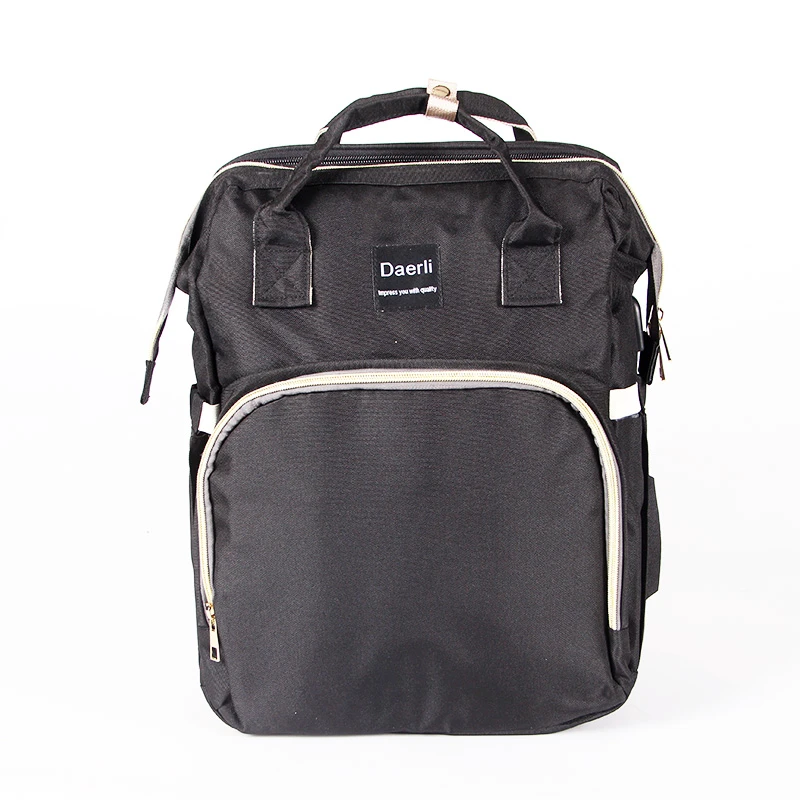
Model-level evidence answers part of this. One Meier diaper bag backpack model is built as a daily multi-function nappy bag in a water-resistant fabric with zipper hardware, listed at 30 x 18 x 42 cm with a customizable size, a zipper closure and a polyester shell and interior. Instead of a written claim, the brand can compare its own construction requirements against the documented nappy bag model and see which parts of the build are already documented.
A pre-production sample covers material, craftsmanship, colour and functionality, which is why it is worth producing before the pricing conversation is finished. The sample shows whether the chosen lining can be sewn into the corners the design needs, whether the zip runs cleanly through the opening, and whether the stroller straps carry the loaded bag.
Whether a brand works with a diaper bag supplier or directly with a manufacturer, that sample is the shared reference for every later conversation. When the sample room is treated as a formality, the specification usually gets the same treatment.
Most quotation disputes trace back to a brief that left something open. The brief does not have to be long, but it has to answer the questions that change the price: size and packed dimensions, shell and lining material, colour direction, printing and logo method, hardware, packing, quality expectations and quantity by colour.
For a diaper bag brand, the brief should also carry the commercial assumptions behind the design. If the plan is a two-colour launch with a small first order, say so. If the plan is a single colour with a repeat order in mind, say that instead. The same bag can be quoted differently depending on what the production slot has to support.
Size, material, lining, hardware, printing, packing and quantity by colour each move the quotation, and most of them move lead time as well. Writing them down once is faster than negotiating them one at a time after a price has been given.
The brief should also state what the brand will supply. Logo artwork, colour references, packaging files and the target launch date all belong in the first request, because each one can otherwise become a follow-up that delays the quotation without changing the product. A bag line specified in this way can be handed between manufacturers without rewriting the requirement each time, which is the discipline a design-line brief applies to a different product family.
Minimum order is normally quoted per design and per colour, so the assortment plan changes the commercial answer. The current Meier nappy bag model, for example, is listed at 300 pieces for each design and colour, while the official category page describes a broader by-design range. The model figure belongs to that model and is reconfirmed in the quotation rather than carried across to a new layout.
That means the colour plan has to be decided early, not after sampling. Adding a third colourway late can invalidate the piece count the brand assumed, and the schedule moves with the quantity.

Customization is easiest to manage when it is defined as a scope rather than a wish list. Size, colour, printing, logo method and structure each carry a different production consequence, and the brand should know which of them are still open before the sample is approved.
A documented base model makes that conversation concrete. An existing construction becomes the reference: the buyer names which parts to keep, which to change, and which must stay untouched for the design to remain manufacturable at the quoted cost.
The Meier nappy bag model supports size, colour and printing changes, and allows logo and design changes within the documented construction. Those options exist because the base build is already proven. Changing the outer material, the lining specification or the hardware family is a larger decision than changing a colourway, and it should be raised before sampling rather than after.
The cleanest brief separates the two. Customization that stays inside the documented base can be quoted quickly; a change that creates a new construction should be priced and sampled as its own version.
A change after sample confirmation can affect the quotation, lead time and production schedule, because bulk production follows the approved sample. The documents exist for a reason: once measurements, materials, colour, logo method, hardware and packing are tied to an approved version, the production line can repeat it.
Treating that change as a new revision keeps the sequence honest. The brand keeps an approved reference for the current order, and the new request is priced against its own timeline instead of delaying the version already in production.
Origin is usually discussed as a cost question, but the operational effects matter more. A manufacturing base changes how many sampling rounds are practical, how quickly revisions can be returned, and what kind of third-party inspection is available before shipment. Deciding that before the brief is written avoids renegotiating the plan later.
For diaper bag brands the practical question is not which country is cheapest, but which manufacturing base can deliver the construction the design needs with a predictable sampling cycle and an inspection process the brand can verify.
Sampling is planned at 5-7 days and bulk production at 30-45 days once the order details are confirmed. Those planning figures assume the materials and revision count are settled, so the brief should say whether a second sample round is likely. Planning for one sample round when two are likely means planning against the wrong schedule.
Quality control should be part of the order, not a hope attached to it. Incoming fabric, hardware, zippers, threads and accessories are checked on arrival for material type, colour consistency, texture and thickness, and non-conforming material is held back before cutting. In production, cutting accuracy and cut-piece defects are checked, sewing is inspected for stitching tightness, evenness, edge alignment and seam durability, and assembly is verified for correct installation of zippers, buckles, straps and other functional parts.
After production and before packaging, every finished item is inspected for appearance and craftsmanship, and the functional test confirms that zippers, pockets, buckles and shoulder straps work as the design specifies. Before shipment, a final random inspection against the agreed AQL plan covers appearance, structure, functionality, packaging and labelling. Buyers who want to check that expectation from their own side can work through a factory-visit checklist before the order is placed.
The sample is the evidence that the specification can be built, and it should be judged against the brief rather than against a photograph. Colour, texture, stitching, hardware and dimensions all have a tolerance, and the brand should know which ones it will accept before the box is opened.
Load the sample with the items the range is meant to hold. Check whether the change mat folds into its pocket without forcing the zip, whether a full bottle pocket changes the way the bag hangs, and whether the interior stays reachable once the bag is packed. Photograph the loaded sample and keep the photograph with the approval record so the bulk order has a reference point.
Approval should fix measurements, shell and lining, colour, logo method, hardware, pocket count and packing. Those recorded values let a factory repeat the product and let the brand compare a future sample against something concrete. Where the brand wants a different version later, the change is raised as its own specification rather than absorbed into the current order.
Qualifying a diaper bag manufacturer is easier when the brand arrives with a specification instead of a picture. Confirm the capability first, brief the manufacturer so quotes are comparable, fix the customization scope before approval, plan sampling and quality control around the chosen origin, and approve the sample on recorded evidence. Sampling is planned at 5-7 days and bulk production at 30-45 days once those details are settled, which makes the qualification decision a schedule the brand can plan around.
Q1: What should a brand send when requesting a diaper bag manufacturer quotation?
A1: Send the load list, compartment sketch or reference, size, material and colour direction, logo and packing scope, quantity by colour, sample request and launch window. Ask the manufacturer to confirm the current minimum order, sample and bulk timing, and inspection scope in the quotation.
Q2: How do I compare diaper bag manufacturers fairly?
A2: Compare them against one brief. Ask which construction steps they perform in house, what the pre-production sample covers, which changes stay open after approval, and how incoming material, in-process work and finished bags are inspected before shipment.
Q3: Does the manufacturing location change the sampling plan?
A3: It can, because origin affects sampling rounds and logistics. Plan sampling at 5-7 days and bulk production at 30-45 days with the materials and revision count confirmed, and treat a second sample round as a scheduled event rather than an exception.
Please fill out the form below and we will get back to you as soon as possible.